What a Wide Abrasive Belt Actually Costs | Motico Solutions
A purchasing manager runs a furniture factory in Riyadh. Two wide abrasive belt suppliers approach with quotations.
Supplier A offers stock zirconia P80 belts at a competitive unit price.
Supplier B — Motico Solutions, a converter in Lebanon — offers converted-to-specification zirconia P80 belts at a unit price 33% higher.
The purchasing system flags Supplier A as the better deal. Over 200 belts per year, the per-belt savings look substantial. The procurement decision looks obvious.
It is not obvious. It is wrong. And the reason is that wide abrasive belts are not priced by the unit — they are priced by the square metre of finished workpiece they produce.
This article explains how to evaluate wide abrasive belts on the metric that actually matters: cost per square metre. It is written for purchasing managers, plant managers, and finance teams who buy industrial abrasives and want to understand what they are actually paying for. The framework reflects how Motico Solutions positions every wide belt quotation to industrial customers across Lebanon and MENA.
Why Unit Price Misleads Industrial Belt Buyers
A wide abrasive belt is not a finished good in the way a tool or a fastener is. The buyer is not actually purchasing a belt — they are purchasing a quantity of finishing capacity, measured in square metres of workpiece sanded before the belt needs replacement.
The unit price of the belt is the cost to acquire that capacity. The amount of capacity actually delivered depends on:
The cutting life of the abrasive grain
The integrity of the joint under sustained tension
How well the belt tracks on the specific machine
How efficiently the abrasive contacts the workpiece during operation
How quickly the belt loads with workpiece material
How predictably the belt fails (gradual versus sudden)
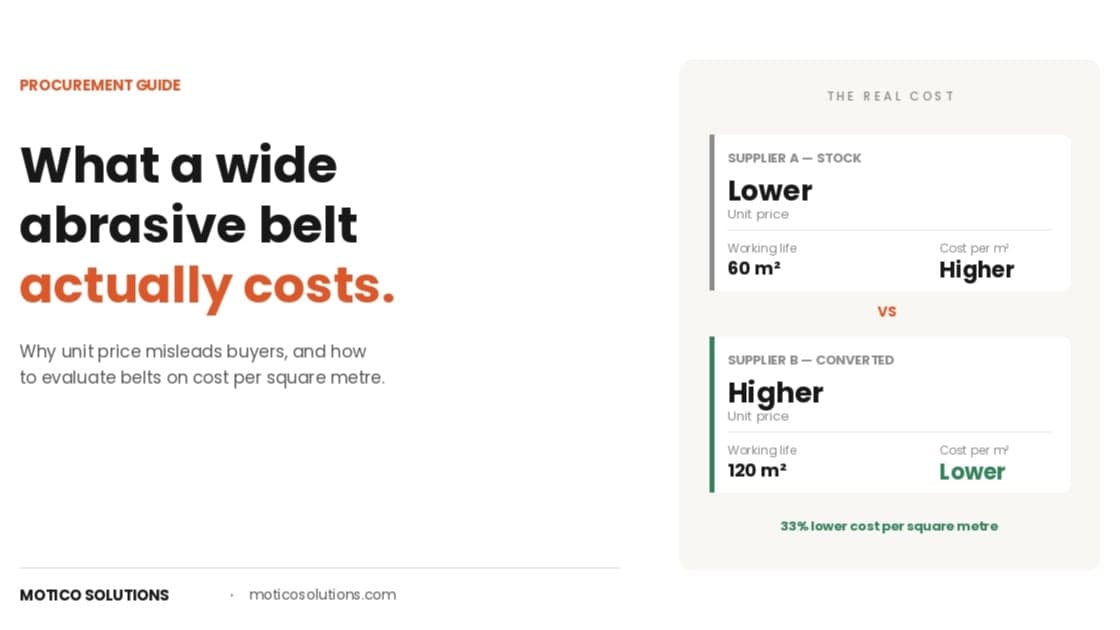
Consider two belts. Belt A costs less per unit but produces only 60 square metres of finished surface before replacement. Belt B costs 33% more per unit but produces 120 square metres — double the working life.
Belt A's cost per square metre is the unit price divided by 60. Belt B's cost per square metre is the unit price divided by 120. Even though Belt B costs more per unit, it delivers a cost per square metre that is 33% lower than Belt A.
The more expensive belt is the cheaper purchase, by a third.
This is the calculation that separates serious industrial buyers from buyers who optimise for the wrong metric. It is also the calculation that Motico Solutions uses internally when specifying belts for customers — because the belt that delivers the lowest cost per square metre is the belt the customer will want to reorder.
How to Calculate Cost Per Square Metre
The calculation has three inputs: the cost of the belt, the working area of the belt, and the working life of the belt under your specific conditions.
Step 1: The Cost of the Belt
This is the simplest input. Include the unit price, plus any freight, customs, and handling that is specific to each belt. For belts purchased domestically, this is usually the invoice price plus delivery. For belts imported, this includes shipping, duties, and broker fees allocated per belt.
Step 2: The Working Area of the Belt
A belt's nominal dimensions describe its physical size, not its working area. The working area is the surface that contacts the workpiece during operation, calculated as:
Working area (m²) = belt width (m) × belt length (m)
A 1,300 mm × 2,620 mm belt has a working area of 1.3 × 2.62 = 3.4 square metres.
Note that this is the belt's area, not the workpiece area. The belt sands many square metres of workpiece per square metre of belt — typically 50 to 200 times its own area before the abrasive is exhausted, depending on the application.
Step 3: The Working Life of the Belt
This is the input that varies most between belts, and it is the one most buyers fail to measure properly.
The working life is the total square metres of workpiece a belt processes before it must be replaced. It depends on:
The hardness of the workpiece material
The stock removal rate the operator targets
The contact pressure on the machine
The temperature of the workpiece during sanding
Whether the belt loads with material residue
The integrity of the belt joint under tension over time
For a given application, working life is the most reliable performance metric a buyer can record. Tracked over time, it produces the data needed for genuine cost comparisons.
The Calculation
Cost per square metre = belt cost ÷ working life
A belt that costs more per unit but processes twice the workpiece area delivers a substantially lower cost per square metre. The unit price comparison conceals this. The cost-per-square-metre comparison reveals it.
What Drives Working Life Variation Between Belts
Two belts at the same grit and grain can have working lives that differ by a factor of two or more. The reasons are not always visible to a purchasing manager evaluating quotations.
Grain quality and chemistry. Premium zirconia and ceramic grains from established manufacturers (Hermes, 3M, VSM) produce more consistent cuts and last longer than economy alternatives at the same nominal grit. Motico Solutions converts on Hermes Schleifmittel cloth specifically because the grain consistency directly affects how long the finished belt lasts on the customer's machine.
Bond coat quality. The adhesive that holds the abrasive grain to the backing is the most overlooked component of a belt's performance. A weak bond releases grain prematurely and shortens belt life. A bond optimised for the workpiece and the machine speed retains grain through its full cutting life.
Backing weight and stretch behaviour. Lighter backings flex more, contact the workpiece differently, and produce different working lives on the same machine. Belts converted with the right backing for the machine — not the cheapest available backing — last longer.
Joint type and integrity. The joint is the most stressed part of any wide belt. A joint that is wrong for the machine speed or contact roller diameter will fail before the abrasive is exhausted, wasting all remaining working life. Custom-specified joint types extend working life on machines that fall outside standard configurations.
Dimensional accuracy. A belt that is 2 mm long or short of its specified length runs at incorrect tension, which accelerates wear and shortens working life regardless of how good the abrasive grain is.
These factors are why stock belts and converted-to-specification belts can have working lives that differ substantially, even when they appear identical on a quotation.
What Cost-Per-Square-Metre Means for Procurement Decisions
For purchasing managers evaluating wide abrasive belt suppliers, three actions follow from the cost-per-square-metre framework.
A Worked Example
A stainless steel tank fabricator in Lebanon runs three wide belt sanders in a single shift, processing 200 square metres of stainless workpiece per day across the three machines.
Annual workpiece volume: 200 m² × 250 working days = 50,000 m²
If the shop uses belts that cost three units per square metre processed, the annual belt expenditure equals 150,000 cost-units.
If the shop switches to a supplier whose belts deliver two units per square metre — a 33% lower cost per square metre — the annual belt expenditure drops to 100,000 cost-units. The shop saves one third of its annual belt budget, despite the per-belt price being higher.
The unit price comparison would have suggested the wrong supplier. The cost-per-square-metre comparison identifies the right one.
This is the metric that experienced industrial buyers use, and it is the metric that separates a procurement function from a finance function.
How Motico Solutions Supplies for Total Cost Performance
Motico Solutions converts wide abrasive belts on premium German cloth (Hermes Schleifmittel), specified to the exact dimensions and joint configuration of each customer's machines. The approach is built around economic performance:
Belts converted to specification, not forced from stock dimensions
Grain and bond chemistry matched to the workpiece, not selected by default
Joint types selected to suit machine speed and contact geometry
Documentation provided with every belt, enabling consistent reorders and accurate cost tracking
Delivery from Beirut to GCC and MENA destinations in 3 to 5 working days
For customers building cost-per-square-metre records and looking to consolidate belt supply across multiple machines, Motico Solutions provides the technical consultation needed to specify belts correctly the first time.
For pricing, technical advice, or to discuss your belt cost performance, contact Motico Solutions.
Need Expert Advice?
Our technical team is ready to help you find the right solutions for your application.
Contact Us