
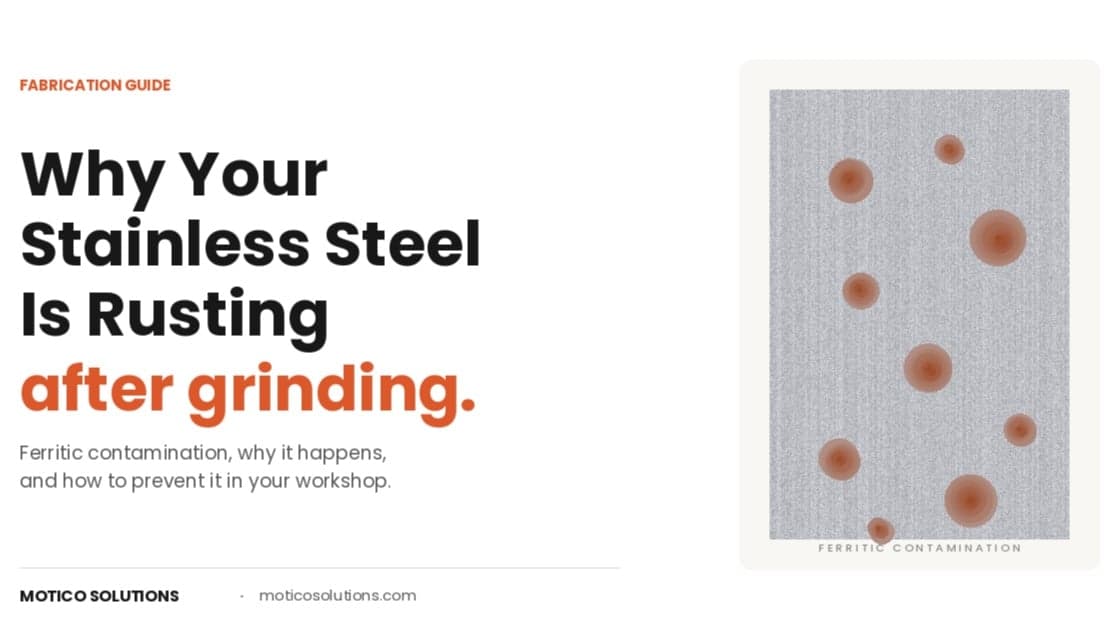
Why Your Stainless Steel Is Rusting After Grinding
You finished the job. The weld looks clean, the surface is smooth, and the stainless steel tank, pipe, or railing is ready for delivery. Three days later, the customer calls — there are rust spots all over it.
If this sounds familiar, the problem almost certainly isn't your stainless steel. It's what you used to finish it.
This article explains the most common cause of rust on freshly finished stainless steel, why it happens, and the simple changes that prevent it.
---
Stainless Steel Doesn't Rust — Unless You Make It
Stainless steel resists corrosion because of its chromium content. When the surface is exposed to oxygen, the chromium forms a thin, invisible "passive layer" that protects the metal underneath. As long as this layer is intact and uncontaminated, the steel stays bright.
The problem starts when foreign particles get embedded into the surface during grinding, brushing, or polishing. These particles break the passive layer and bring their own corrosion behaviour with them. The most damaging contaminant is iron from carbon steel tools.
This phenomenon has a name: ferritic contamination.
---
What Causes Ferritic Contamination
Ferritic contamination happens when carbon steel particles transfer onto a stainless steel surface during finishing work. The particles embed into the metal, oxidise on contact with moisture or humidity, and create rust spots that look exactly like the stainless itself has failed.
The most common sources are:
Carbon steel wire brushes. A standard wire brush has bristles made from carbon steel. Every pass over stainless leaves microscopic iron deposits in the surface.
Grinding discs previously used on carbon steel. A flap disc, fibre disc, or grinding wheel that was used on mild steel earlier in the day will carry iron residue into the next stainless job.
Shared workbenches and clamps. Stainless workpieces resting on surfaces contaminated with carbon steel grinding dust pick up the same particles.
Sparks from nearby carbon steel work. Hot carbon steel sparks landing on stainless can also embed iron into the surface.
The contamination is often invisible at first. The rust appears hours or days later, after moisture in the air activates the iron particles.
---
How to Prevent Ferritic Contamination
The principle is straightforward: anything that touches stainless steel must be free of carbon steel residue.
1. Use Dedicated Stainless Steel Wire Brushes
Replace carbon steel brushes with stainless steel bristle brushes for any work on stainless surfaces. These brushes are designed specifically to clean weld seams and surface contamination without introducing iron.
Stainless steel wire brushes are available in hand-brush and angle grinder formats and are essential for any shop working with stainless components.
2. Reserve Abrasives for Stainless Only
Mark and store flap discs, fibre discs, and grinding wheels used on stainless steel separately. Once a disc has been used on carbon steel, it should never go back onto stainless.
Many fabricators colour-code their discs or use separate storage racks for stainless-only abrasives.
3. Match the Abrasive to the Material
For stainless steel, the right abrasive matters. Zirconia and ceramic abrasives cut cooler and reduce heat build-up, which lowers the risk of surface discolouration and embedded contamination. Non-woven fleece wheels are ideal for blending and finishing without aggressive material removal.
4. Keep the Workspace Clean
Use dedicated work tables or cover existing benches when handling stainless workpieces. Vacuum or wipe down surfaces between carbon steel and stainless jobs. Avoid grinding carbon steel in the same area as exposed stainless work.
5. Passivate After Finishing
After grinding, polishing, or welding, stainless steel benefits from a passivation process to restore the chromium oxide layer. Citric acid solutions and commercial passivation products are widely available and remove residual contamination while strengthening the corrosion-resistant surface.
---
A Common Mistake to Avoid
Some shops attempt to "save" a contaminated stainless surface by re-polishing it with the same tools. This usually makes the problem worse — the polishing process embeds the iron particles deeper rather than removing them.
The correct approach is to mechanically remove the affected surface layer with clean stainless-rated abrasives, then passivate.
---
What This Means for Your Shop
Rust on stainless steel after finishing is almost always preventable. The cost of dedicated stainless brushes and a colour-coded abrasive system is small compared to the cost of reworking a contaminated job or losing a customer.
If your shop frequently handles stainless steel work for food and beverage equipment, pharmaceutical tanks, dairy processing, or architectural metalwork, the standard should be a separate set of tools and abrasives reserved for stainless only.
---
Motico Solutions Supplies the Right Tools
Motico Solutions stocks a full range of stainless-rated finishing tools for fabricators across Lebanon, including:
- Stainless steel wire brushes (hand and angle grinder formats)
- Zirconia and ceramic flap discs engineered for stainless steel
- Non-woven fleece wheels for blending and finishing
- POLY-PTX longitudinal grinders by Eisenblätter for professional surface finishing on tanks and pipes
- Wide abrasive belts converted to specification in zirconia, ceramic, aluminium oxide, and silicon carbide
---
Motico Solutions is Lebanon's specialist supplier of industrial surface finishing tools and abrasives. Authorised reseller of Eisenblätter (Made in Germany).
Need Expert Advice?
Our technical team is ready to help you find the right solutions for your application.
Contact Us